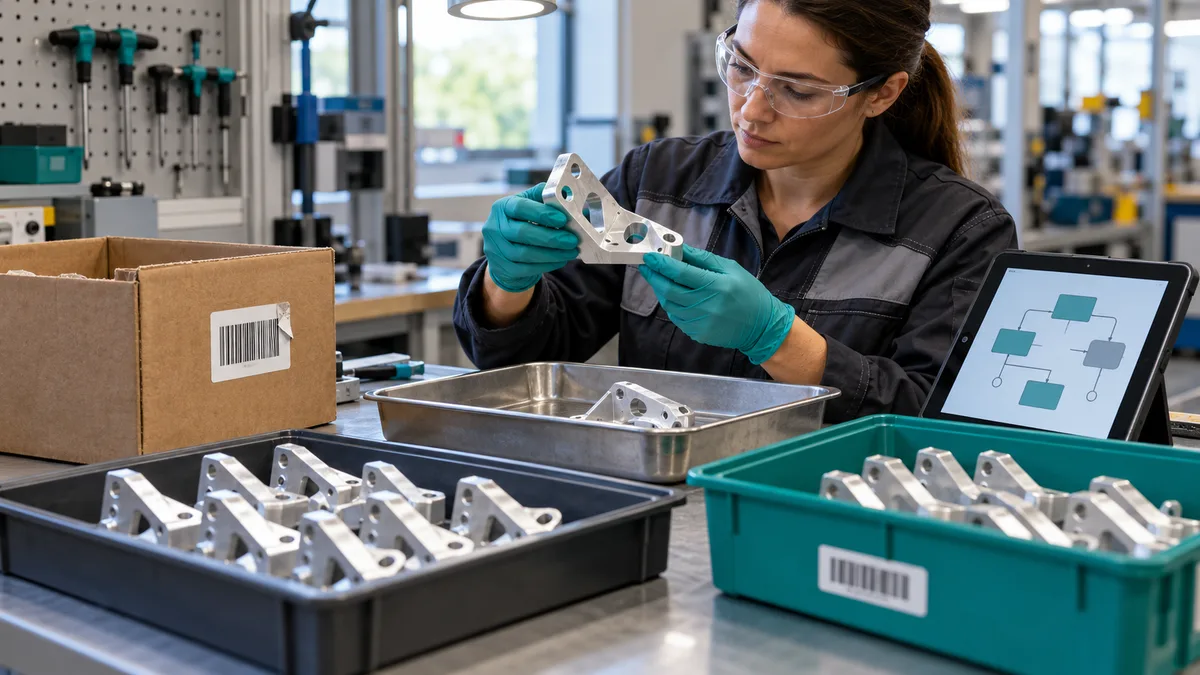
Lot tracking software should trace a returned part through recorded shipment, production, and material transactions. When its lot label is missing, the system should show the possible sources and the evidence still needed, not quietly assign a convenient lot. A shipment number can narrow an investigation without proving which lot an individual part belongs to.
This guide gives small-manufacturer quality, stores, and operations teams a practical buying test: receive five returned pieces from a mixed-lot shipment, identify some of them, and preserve the uncertainty around the rest. It is useful when evaluating a new system or improving an existing returns workflow.
Start with identity, not a search box
A lot identifies a group; a serial number identifies an individual unit within the identification scheme you use. A shipment identifies a movement to a customer. These references answer different questions. Even a perfectly searchable shipment record cannot supply unit-level evidence that nobody captured.
As a product-specific example, Microsoft's item-tracing documentation describes tracing historical inventory transactions using an item number and a tracking dimension such as batch, serial, or vendor batch. This illustrates why recorded identifiers matter; it is not a claim that every product has the same functions or limitations.
Before a demonstration, agree which identifiers your team actually records at receipt, consumption, packing, and dispatch. For the wider workflow, see our batch and lot traceability guide. For stock movements and balances, use the main inventory management guide for small manufacturers.
Test a return from a mixed-lot shipment
Hypothetical example: a factory ships 50 brackets of item P-210 to one customer on shipment S-17. The packing record shows 30 pieces from finished lot F-101 and 20 from F-102. Later, the customer returns five pieces and references S-17, but their lot labels are unreadable. Assume the returned item and shipment reference have been checked; no other lot-identifying evidence is yet available.
- Create the return record. Record the five pieces, customer, item, shipment reference, receipt time, physical location, condition, and investigation owner.
- Keep the stock controlled. Under the agreed quality process, receive these pieces into a held state, physically separated from released stock. An unidentified return must not silently become available for dispatch.
- Record candidate sources. S-17 supports F-101 and F-102 as possible source lots. Neither is a confirmed identity for any of the five pieces yet.
- Preserve the missing evidence. Record what is unreadable, retain photographs, and request relevant packing or identification records. Do not fill a required lot field with a guess just to finish the receipt.
If the software requires a temporary identifier, make it an explicitly unresolved return identifier linked to the candidate lots. It must not appear in trace reports as a genuine production lot or as proof of origin. Agree how the temporary record will be resolved and how it appears in stock and investigation exports.
Separate three confirmed pieces from two unknowns
Continue the example: documented individual markings, matched to a retained packing record, now establish that three returned pieces belong to F-101. The other two still have no reliable identifying evidence. The correct result is three confirmed pieces from F-101 and two unresolved pieces whose candidates remain F-101 or F-102.
Do not assign the remaining two to F-102 merely because F-101 already has a match. Do not use FIFO, the most recent production date, or the invoice's first line as proof. Those may be useful search clues, but they are not a substitute for a recorded link.
Store the evidence reference, reviewer, decision time, and reason against the three-piece identification. Preserve the earlier unresolved state in the history. A second person opening the case should be able to understand why the identity changed without asking whoever performed the update.
If your process allows statistical assumptions or a conservative investigation scope, label those separately from confirmed trace links. A quality team may decide to investigate both candidate lots; that does not mean all returned pieces have been proven to belong to both lots.
Keep the shipment history and return balance distinct
S-17 still records 50 pieces originally shipped: 30 from F-101 and 20 from F-102. The five-piece return is a linked later movement, not an edit that changes the original shipment to 45. In this simplified example, assume no other movements: 45 pieces remain with the customer and five have returned.
The total movement balance is known, but the exact remaining quantity by lot is not. Three returned pieces are confirmed as F-101; the other two are unresolved. A report that provides precise net customer quantities for both lots without acknowledging those two pieces is presenting an assumption as a fact.
Ask the supplier to show both the original dispatch and the return ledger. A trace view may display the same relationship in several branches; that should not multiply the physical quantity. Also keep identity and disposition separate: establishing a lot does not release the returned stock. Inspection and release follow the team's non-conformance and hold-to-release workflow.
Trace backward, then check the wider scope
For the three confirmed pieces, trace F-101 back to its production job and the actual material issues recorded for that job. Do not substitute the planned bill of materials for actual consumption. If multiple material lots fed one finished lot without finer segregation, the trace may identify a group of possible input lots rather than the exact material in a particular bracket.
Next, inspect forward links from the relevant production or material records to other finished lots, stock locations, and shipments. Do not stop at the customer's single return. Keep this search separate from the two unresolved pieces and record the criteria and time of each report.
A trace link establishes recorded provenance, not the cause of a defect. Shared material, equipment, or timing can help define an investigation, but the quality team still needs evidence to determine the problem and the appropriate action.
The broader importance of connected records is reflected in NIST's September 2026 manufacturing traceability announcement, which describes an industry-neutral approach to exchanging and verifying traceability information. That is business context, not a requirement that every small factory purchase a particular system.
Use this lot tracking software acceptance checklist
- Mixed shipment: the demonstration preserves separate 30-piece and 20-piece lot allocations within S-17.
- Incomplete identity: five pieces can be received under control without inventing a source lot.
- Partial identification: three confirmed pieces and two unresolved pieces remain distinguishable on screen and in exports.
- Quantity history: the original 50-piece dispatch remains intact alongside the later five-piece return.
- Trace scope: users can follow actual recorded consumption and dispatch links, with gaps and filters visible.
- Controlled corrections: identity changes retain evidence, previous values, reasons, and reviewer details.
- Separate release: a successful identity match does not automatically clear a quality hold.
- Repeatable evidence: an exported report includes its criteria and creation time so a later report can be compared meaningfully.
Mark each test pass, fail, or unresolved and keep the supporting transaction references. These are proposed acceptance conditions, not claims about a named product's existing capabilities. Start with one returned-item scenario from your operation, remove confidential details, and ask the supplier to demonstrate the whole path rather than a prepared search result.
Define a traceable returns workflow
Share how your team identifies returned parts and connects them to shipments with Ploqy Technologies. We can discuss a manufacturing software scope around your records, evidence gaps, and approval process.
Continue with a related guide
- Batch and lot traceability for small manufacturers
- Non-conformance software: hold-to-release workflow
- Inventory management software for small manufacturers
Manufacturing software servicesManufacturing website servicesDownload the project checklist
Published by Ploqy Technologies. About our guides and editorial process.