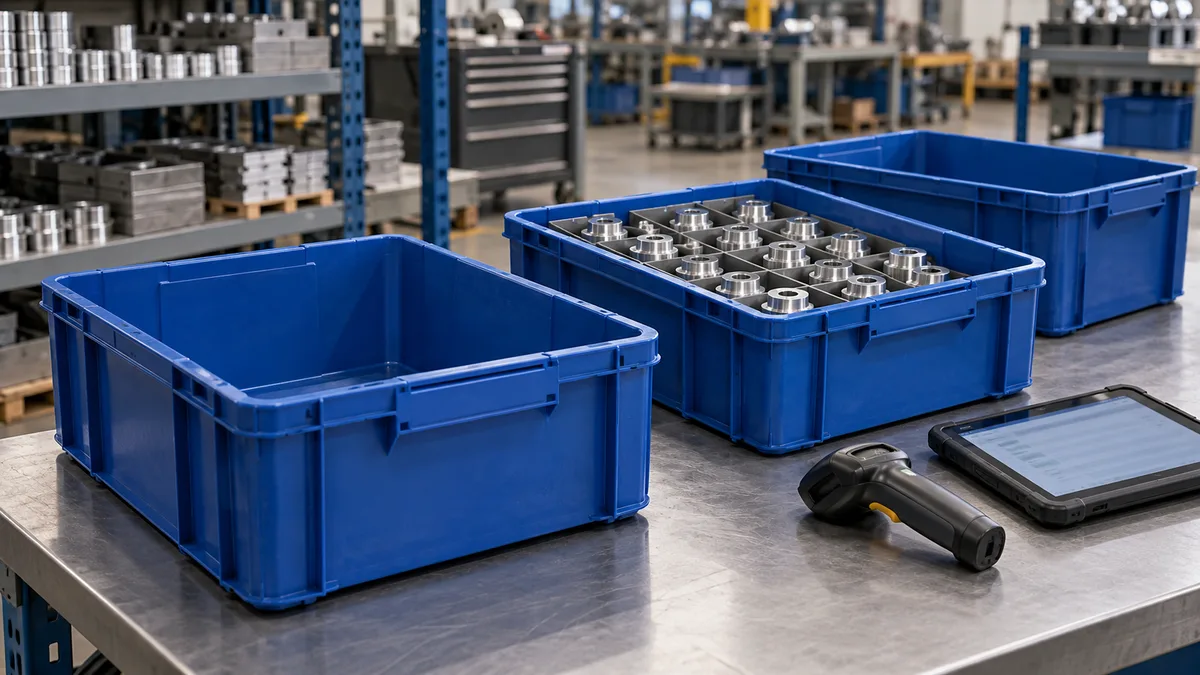
Returnable packaging tracking software should follow the reusable container and its material contents as separate records. Receiving an empty tote must not create parts in stock. Returning that tote must not remove parts that were already unpacked. Link the two records for each loaded trip, then change the contents when a new trip carries a different quantity.
This guide helps small manufacturing purchasing, stores, and dispatch teams evaluate that boundary. It is written for US manufacturing buyers, with the same practical test usable in India and other markets. The example concerns ordinary reusable component totes, not hazardous-material packaging or a specialized compliance process.
Separate the tote, the contents, and the trip
A returnable tote is a reusable carrier. The components inside are material inventory. A trip records a particular movement of that carrier, possibly loaded or empty. These records answer different questions: where is the tote, what material is available, and what moved on this delivery?
GS1 describes the Global Returnable Asset Identifier (GRAI) as an identifier for reusable transport assets such as trays, crates, and pallets. GS1 Sweden explains that a serial number can identify an individual carrier and that carrier movements can be recorded when shipping goods or returning it empty.
For your demonstration, use stable internal tote IDs or an agreed partner identification scheme. Do not label an invented internal code as a valid GRAI. Agree identification with trading partners before adopting an external standard. The important software question is whether the carrier identity persists while its contents and trip references change.
An inventory system for manufacturers still needs the normal item, unit, quantity, location, and stock-status records. Our main manufacturing inventory guide explains that foundation. Packaging tracking should connect to it without creating a second, competing material balance.
Record ownership separately from physical custody
A supplier-owned tote can be physically in your receiving area. Your own tote can be at a subcontractor. Record the owner, current confirmed custodian or location, carrier type, and condition without treating these as interchangeable facts.
Decide whether each carrier needs an individual ID. A count by owner and tote type may be adequate for some low-value pools, but it cannot explain the history of one specific damaged tote. If you require individual histories, test individual identities throughout receipt, transfer, return, and repair.
Use distinct states for return dispatched and return confirmed by the partner. A driver collecting three totes is a recorded handoff; it is not necessarily the supplier's acceptance of those three. Keep the movement reference, date, quantity or IDs, destination, and acknowledgment evidence available for reconciliation.
Test six totes across two loaded trips
Hypothetical software demonstration: a supplier sends six individually identified totes, T-01 through T-06, containing 40 accepted spacers each. Opening material stock and the local record of these six totes are both zero. All material in this example is accepted; no production issues, losses, or quality holds occur.
- Receive the first delivery. Record six supplier-owned totes on site and 240 spacers. Link each tote to its actual 40-piece contents and the receipt reference. Receiving the delivery once must not add another 240 through a separate packaging screen.
- Unpack T-01 through T-04. Move their 160 spacers to a stores bin. T-05 and T-06 still hold 80 spacers together. Material remains 240 pieces: 160 loose plus 80 contained. All six totes remain on site, four empty and two loaded.
- Return T-01, T-02, and T-03 empty. On dispatch, show three totes on site and three in the return movement. Material remains 240 pieces. After the supplier confirms receipt, those three totes have a confirmed supplier location; the movement is no longer awaiting acknowledgment.
- Receive T-01 and T-02 again. This time each carries 20 accepted spacers. Add 40 pieces, giving 280. There are five of these known totes on site and one, T-03, still confirmed with the supplier. Do not create two new asset identities for the returning totes.
The final material breakdown is 160 loose pieces plus 120 in four loaded totes equals 280 pieces. T-04 is the fifth tote on site and is empty. The carrier record reconciles the original six as five on site plus one with the supplier. This describes these six tracked assets, not the supplier's entire tote pool.
The first receipts for T-01 and T-02 must still show 40 pieces each; their later receipts show 20. Updating the current contents must not rewrite the earlier delivery. A standard tote capacity is useful planning information, but it is not proof of the quantity inside on any particular trip.
Keep discrepancies attached to the right record
Now vary the demonstration. If the supplier confirms only two of the three dispatched empty totes, leave the third as an unresolved carrier discrepancy against that return movement. Do not reduce material stock, because no material was sent back in those empty totes.
If a loaded tote arrives short, record the counted material quantity and the receipt discrepancy. The carrier may have arrived correctly even though its contents did not. If a tote is damaged, its condition can prevent reuse while accepted parts removed from it remain available under your material process.
Test a repack as well: transfer a known quantity from one tote to another without receiving the same parts again. Preserve the material identity and relevant lot references. A carrier ID alone is not a substitute for the contents history when the same tote carries different items or lots on later trips.
Partner balances also need an agreed starting point. Reconcile a dated opening list and subsequent movements rather than assuming the first transaction you import represents the complete history. Keep a disputed movement visible until the responsible person resolves it.
Agree which system posts each material movement
During a software review, ask which record creates the material receipt: the purchasing system, warehouse application, or packaging module. The other records should reference that receipt. A loaded-tote scan and an invoice import must not independently receive the same parts.
Try an empty-return event at the interface boundary. It should update packaging custody without generating a material issue. Then try the second loaded trip with the same tote IDs and different quantities. The asset history should continue while a new, distinct material receipt is created.
Packaging and material may use related screens, but their balances should remain readable independently. For fixed pack conversions, use our boxes-to-pieces guide. A reusable tote with changing contents needs more than a permanent pieces-per-box factor.
Bring a packaging reconciliation test to the demo
- Separate balances: show carrier counts and material quantities independently at each step of the six-tote example.
- Persistent identity: returning T-01 uses its existing asset record with a new trip and new contents.
- Empty return: sending or receiving an empty tote changes no material quantity.
- Partner discrepancy: an unconfirmed carrier remains visible without inventing a stock adjustment.
- History and export: retrieve owner, custodian, condition, trip references, acknowledgments, and linked material receipts with understandable units.
Record expected and observed results with transaction references. These are proposed acceptance conditions, not claims that Ploqy or every package already supports them. Start with one carrier type and one trading partner, and expand after both sides can reconcile the same movements.
Make packaging and material balances easier to explain
Bring a non-confidential tote movement example and your current stock workflow to Ploqy Technologies. Discuss the records, handoffs, and manufacturing software scope your team needs.
Continue with a related guide
- Build a controlled manufacturing inventory workflow
- Keep purchase packs and stock units consistent
- Plan a barcode receiving pilot
Manufacturing software servicesManufacturing website servicesDownload the project checklist
Published by Ploqy Technologies. About our guides and editorial process.