Lot tracking software should preserve the source behind a lot reference, rather than merge records because their printed codes match. Two manufacturers can use the same short batch text for different material. Equally, two distributors can deliver material from one original manufacturing batch. The software needs evidence of origin, not a rule that every matching string means the same lot.
This guide gives receiving, stores, and quality teams at small manufacturers a concrete evaluation test. It is written for US manufacturing buyers and is also useful in India and other markets. The example concerns ordinary industrial components and proposed software behavior under an agreed factory process.
Keep the printed reference and the internal identity
Separate your internal item code, supplier lot text, manufacturer identity, and internal traceable record. An internal item can represent components approved from several sources. It does not establish that those sources share one manufacturing batch.
As a standards example, GS1 Digital Link's GTIN-plus-batch example combines a product identifier with a batch qualifier. It does not use the batch text alone as the complete identifier. That illustrates the need for context; it is not a prescription to assign invented GS1 identifiers to your factory records.
Preserve the supplier's label exactly, including meaningful leading zeros. Give the internal record a stable reference that transactions can use even when a supplier name changes. Display enough source information beside the short lot text for staff to choose correctly. Our batch and lot traceability guide covers the wider receipt-to-dispatch chain.
Capture where the material actually came from
At receiving, distinguish the company that sold the material from the manufacturer identified on its supporting records. They may be the same organization or different ones. Keep the purchase reference, item, original manufacturer when known, source lot, delivery reference, quantity, unit, receipt date, and evidence links.
Do not promise that supplier plus item plus lot text is a universally unique key. A distributor may handle multiple manufacturers, or a source may reuse short codes over time. Agree the identification scheme for your materials and record uncertainty where the supplied information is incomplete.
A receipt record and a source batch also need not be identical concepts. Several deliveries may belong to a confirmed source batch, while each delivery retains its own quantity, condition, and inspection history. Ask the vendor to demonstrate both views without overwriting the original documents.
Test two sources that both print 0072
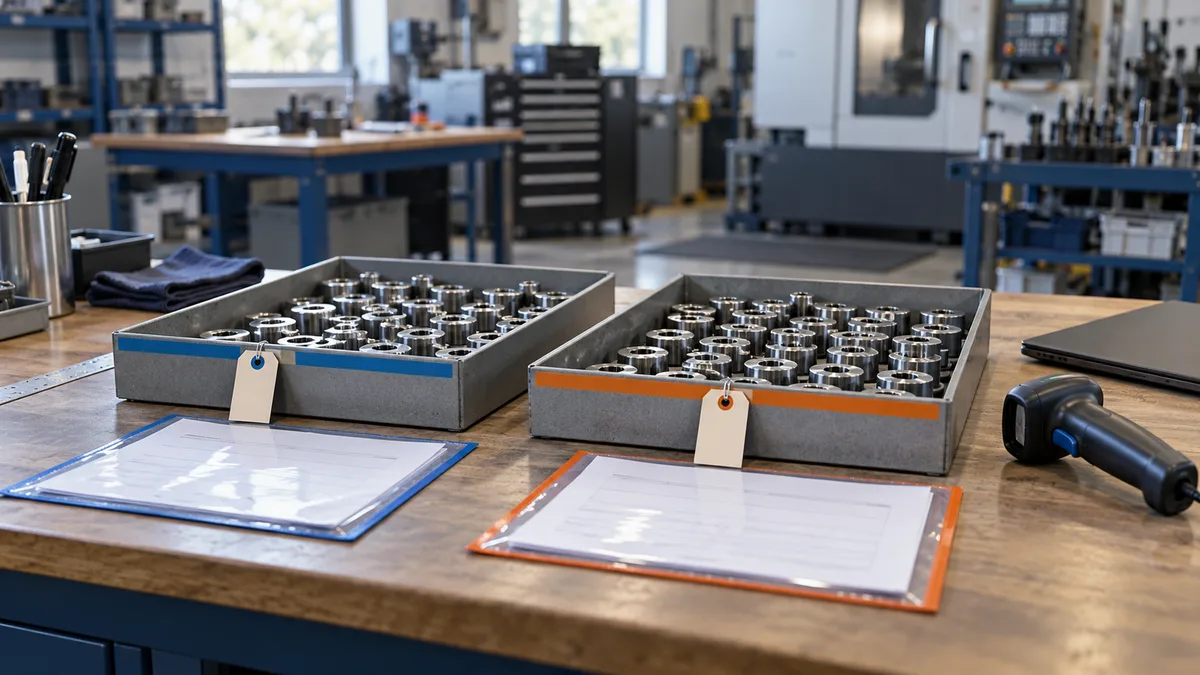
Hypothetical demonstration, not a customer result: your factory buys equivalent collars under internal item C-10. Supplier A delivers 100 pieces made by Manufacturer Alpha; Supplier B delivers 80 pieces made by Manufacturer Beta. Supporting records establish different manufacturing origins, but both label their material lot 0072. Opening stock is zero and both receipts are initially accepted.
- Create two internal records. Assign R-A and R-B as fictional internal trace references. Preserve 0072 on both, linked respectively to Alpha and Beta, their suppliers, and their receipt documents. Do not merge them into one 180-piece source lot.
- Record separate issues. Issue 30 pieces from R-A to Job J-A and 20 from R-B to Job J-B. The store has 70 pieces from R-A and 60 from R-B, totaling 130.
- Search the shared text. Searching 0072 should display both candidates with their item, source, receipt, location, quantity, and status. A scanner or search result should not silently choose the first candidate.
- Review one source. For this test, the authorized quality role places the remaining 70 pieces of R-A on hold for investigation. The report shows those 70 held pieces and the separate 30-piece issue to J-A. R-B still has 60 pieces in its existing status; its matching text alone does not establish a shared origin.
The arithmetic stays explicit: 100 equals 70 in stores plus 30 issued, and 80 equals 60 in stores plus 20 issued. A hold changes availability, not the quantity physically received or issued. Under the test assumptions, store stock is still 130 pieces, with 70 held and 60 available.
The example does not decide the real investigation scope. Your responsible team may review additional material for other reasons. Keep that decision and its evidence distinct from a confirmed source relationship. An issue to a job also does not prove consumption; trace subsequent recorded movements before describing where all issued parts ended up.
Test the opposite case: one batch, two distributors
Now change the evidence. Two distributors supply material documented as coming from the same original manufacturer's batch for the same product identity. Different seller names alone should not prove different origins.
Ask the software supplier to retain two receipt histories while linking them to the confirmed common source batch. A forward investigation can then find both deliveries. If evidence is missing, show a possible relationship for review rather than either merging the records automatically or asserting that they are unrelated.
This distinction matters when designing imports. Deduplicating by printed lot text can collapse different sources. Splitting by vendor name alone can hide a common origin. Document the proposed matching rules and require review for ambiguous cases before importing historical records.
Make scanning resolve the intended record
A supplier label carrying only 0072 cannot supply source fields that it never encoded. Match it within a known receiving or issue context, or ask the operator to resolve the ambiguity. An internal label can point to the stable trace record and display the original reference alongside it.
Test the full round trip through label printing, scanning, CSV export, and reimport. The text 0072 must not quietly become 72 through a numeric spreadsheet field. Preserve original values while maintaining any separately defined search aliases. Our barcode receiving guide explains item confirmation and quantity checks around a scan.
An inventory system for manufacturers should use the selected trace record on the actual stock movement. Changing a report's display label must not redirect earlier issues or change the other lot's inspection status.
Ask for these lot tracking software demonstrations
- Matching text, different origin: keep R-A and R-B distinct throughout receipt, issue, search, and export.
- Known common origin: connect separate distributor receipts to the same evidenced manufacturing batch.
- Ambiguous scan: show candidate records with enough context for a controlled selection.
- Source-specific status: apply the example's hold to R-A without changing R-B merely because the strings match.
- Controlled correction: correct a wrongly selected source with history and linked movement corrections, rather than silently rewriting a posted issue.
- Readable evidence: export original lot text, internal identity, seller, known manufacturer, receipt, quantity, unit, status, and trace links.
Record pass, fail, or unresolved with transaction references. These are proposed acceptance conditions, not claims that every package or a Ploqy product already includes them. NIST's September 2026 manufacturing traceability announcement describes an industry-neutral approach to exchanging and verifying provenance information. It provides broader context, not a mandate to buy a particular platform.
Make material origins easier to trace
Bring a non-confidential example of your receiving labels and source records to Ploqy Technologies. Discuss the identification rules, stock links, and manufacturing software scope your team needs.
Continue with a related guide
- Build a complete batch and lot traceability chain
- Trace a returned part with incomplete identity
- Plan a barcode receiving pilot
Manufacturing software servicesManufacturing website servicesDownload the project checklist
Published by Ploqy Technologies. About our guides and editorial process.