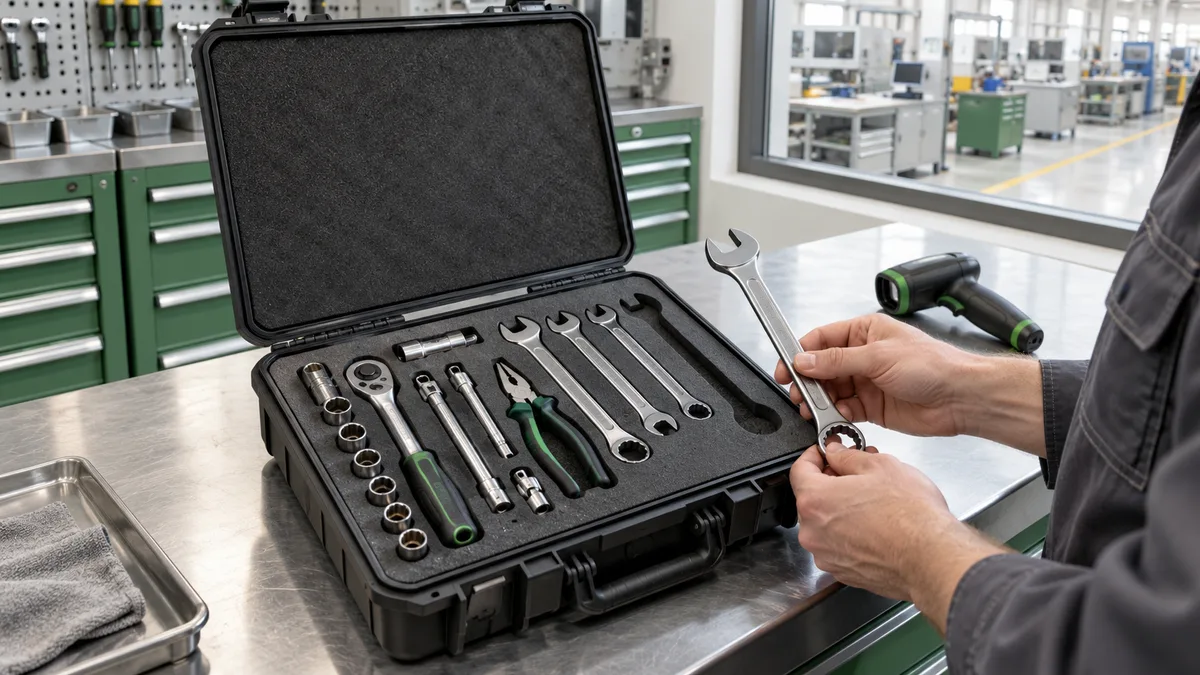
Tool tracking software should close a kit return only after the issued contents are accounted for, with missing or damaged items still visible. Scanning a case back into the tool room proves that the case arrived. It does not prove that every tool inside returned, belongs to that kit, or is ready for the next job.
For a small machine shop or manufacturing maintenance team, a useful software demonstration follows one kit through a partial return, a borrowed component, and an approved replacement. This guide is written for US manufacturing buyers and is equally applicable to factories in India and other markets. It extends our tool checkout pilot with a detailed contents-reconciliation test.
Keep the checkout contents as a historical record
Give the case an identity, then decide how to identify its contents. Individually managed tools need their own stable IDs. Interchangeable items can use a type and quantity when that is enough for your process. A required empty slot and an optional accessory should not be treated the same way.
Save a contents snapshot with each checkout. Include the kit ID, checkout reference, issue time, recipient, job or work area, and the exact required items issued. Record any approved omissions or substitutions before the recipient accepts it. A photo can support the check, but it should not replace the structured list that the return process must reconcile.
The current kit template and the historical checkout serve different purposes. If an administrator adds a new tool to the template tomorrow, yesterday's borrower should not suddenly owe that tool. Equally, removing a missing item from today's template must not erase the outstanding item from an earlier checkout.
Ask to see both views: what the kit normally contains now, and what was actually handed over on a particular issue. If the supplier demonstrates only a single editable list, request this history test before accepting it.
Give returned items more than one status
Record physical receipt separately from the decision to make a tool available. Use clear states that match the factory's process, such as returned and checked, returned awaiting review, still with a confirmed holder, or not yet located. A damaged item can be physically back while remaining unavailable.
Preserve movements as events instead of replacing the previous holder with a new name. For a named-product example, ERPNext's Asset Movement documentation distinguishes transfer, issue, and receipt, retaining earlier movements as history. That illustrates the record pattern; it does not establish kit reconciliation as a feature in every product.
Keep the kit's readiness separate too. A case may be in stores, its return reconciliation may be open, and it may be unavailable for reissue. Staff should see these facts without opening several spreadsheets or interpreting a single ambiguous returned label.
Test one case with six required tools
Hypothetical demonstration: kit K-20 contains six individually identified tools, T-01 through T-06. Checkout C-100 records all six issued to Alex for job J-200. These are fictional records for software evaluation, not a customer result or a recommended kit specification. The case is recorded separately and is not included in the six-tool count.
- Alex returns K-20 with T-01, T-02, T-03, and T-04. Stores checks and accepts those four. T-05 and T-06 have not returned with the case.
- The return shows four accepted tools and two outstanding tools against C-100. The case is in stores, but the required contents are incomplete and the kit is unavailable.
- A separate confirmed transfer shows T-05 was handed to Jamie for job J-201. That item remains part of the unresolved contents account for C-100, while Jamie is its current holder. Alex should not remain its current custodian merely because the original checkout is open.
- T-06 is not yet located. Assign someone to investigate and retain its last confirmed handoff. Do not automatically label it lost or blame its last recorded holder.
- Jamie returns T-05 to stores. After the agreed check, five original tools are accepted back and T-06 remains unresolved. K-20 is still incomplete.
At the first return checkpoint, the six original tools reconcile as four accepted back, one with another confirmed holder, and one not yet located. At the second checkpoint, they reconcile as five accepted back and one unresolved. The open checkout reference preserves the obligation to account for the original six; it is not a claim that Alex still physically holds all outstanding tools.
Add a replacement without rewriting the old checkout
Continue the demonstration with a suitable replacement, T-16. The designated person approves it for K-20 and records when the kit membership changes. It has its own identity; do not rename it T-06 or edit the original checkout to pretend that it was issued earlier.
The kit can become complete with T-01 through T-05 plus T-16 after the required checks and release decision. C-100 still needs a documented outcome for the original T-06. If the process allows checkout closure after an authorized discrepancy decision, retain the linked investigation and its owner until its own work is finished.
If T-06 is later found, receive it against its original identity and history. Do not silently insert it into K-20 and claim the kit now has seven required tools. Record where it goes and whether any further check is needed. The current kit composition and the history of the missing item must both remain explainable.
For measuring instruments, connect the replacement decision to the instrument review and release process. Matching a description or filling a foam cutout does not itself establish that an instrument is approved for the intended inspection.
Make component borrowing affect availability
Try borrowing a component from a kit that is otherwise ready in stores. The confirmed handoff should make that kit's required contents incomplete. If the system still offers the kit for the next job, the contents view and availability rule disagree.
Ask the supplier to demonstrate two clerks trying to issue the same component through different routes: one individually and one as part of its kit. Only the permitted checkout should complete. A case-level reservation should also expose a conflicting component booking before either requester receives a promise.
Allow exceptions only through the factory's agreed process. A team may approve a reduced kit for a specific task, but that should have a defined contents list, recipient acknowledgment, and reason. It must not turn the normal full-kit template into a permanently incomplete standard.
Separate reusable contents from consumable refills
A reusable wrench and disposable inserts create different records. The wrench needs custody and return history; consumed inserts need a quantity issue and, where applicable, replenishment. Do not leave a kit return permanently open because legitimately consumed items will never come back.
If an inventory system for manufacturers supplies those refills, agree the boundary between the tool-room record and the material transaction. Our main inventory management guide explains stock movements and balances. Reference the actual refill transaction once, rather than reducing inventory again each time the case is scanned.
Likewise, a request for a missing replacement is not receipt of that replacement. Keep the kit unavailable until its required contents and approval conditions are actually satisfied, even if purchasing has acknowledged the request.
Bring these return tests to the demonstration
- Wrong component: scan a similar tool from another kit. Show the mismatch instead of accepting it solely because the description matches.
- Repeated scan: scan T-04 twice. It should remain one returned tool, not fill the missing T-06 slot.
- Changed template: edit the current kit standard after checkout. Verify that C-100 still shows its original issued contents.
- Replacement: approve T-16 while retaining T-06's identity and unresolved history.
- Interrupted save: lose the test connection after submitting a return. On recovery, establish whether it saved before retrying; confirm one accepted event.
- Readable export: retrieve the checkout snapshot, component movements, return checks, membership changes, and discrepancy decisions with usable references.
Record the expected result, observed result, and unresolved gap for each case. These are proposed acceptance requirements to discuss with a supplier, not a claim that Ploqy or every tool-tracking package already includes them. Start with one representative kit and the people who actually issue and receive it.
Make kit returns easier to account for
Share a sample kit list and the return exceptions your team encounters. Discuss the workflow and manufacturing software scope with Ploqy Technologies.
Continue with a related guide
- Plan a tool checkout pilot
- Review instrument release requirements
- Control manufacturing inventory movements
Manufacturing software servicesManufacturing website servicesDownload the project checklist
Published by Ploqy Technologies. About our guides and editorial process.